Michael Bay
The Eulogy of a Michael Bay fan

4/8/22 - 5/26/24
My blog was obviously erected as an ode to my favorite director, both in name and in spirit. Though not on the blog now, the first piece I wrote was a review of the new film, The American Society of Magical Negroes. If you're wondering what I thought about it, quite simply, I hated it. In my review of it, I posited that it would have been a much more interesting and subversive movie if it was directed by Michael Bay. Not because I think that Bay particularly fits the material or is even interested in the material. But because he's an old-fashioned filmmaker, somebody that understands that a story is told in images first and foremost.
The reason that I'm writing this piece is not because Bay is actually no longer my favorite director, but rather to tether myself to him even after he's no longer my favorite filmmaker (as if the blog name wasn't enough). I can see how my relationship to his work is no longer what it once was, for the simple fact that I'm not immersed in his filmography as I had been for the past few years. Though watching eight movies from a single filmmaker over the course of twelve months might not sound like much. For Bay to have been my most watched director two years running was a pretty remarkable feat.
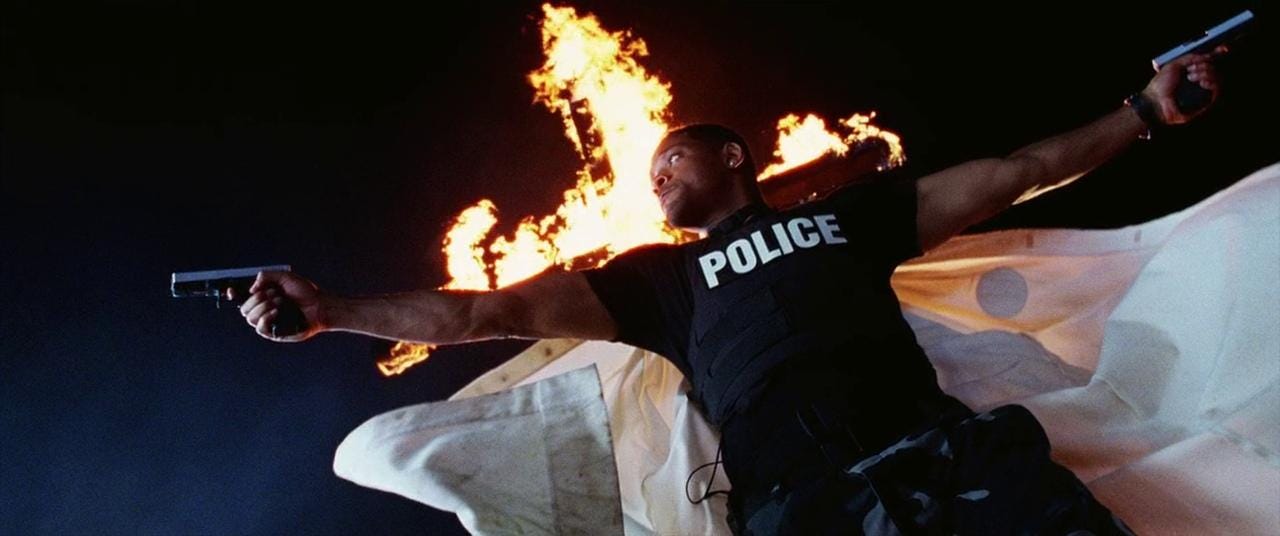
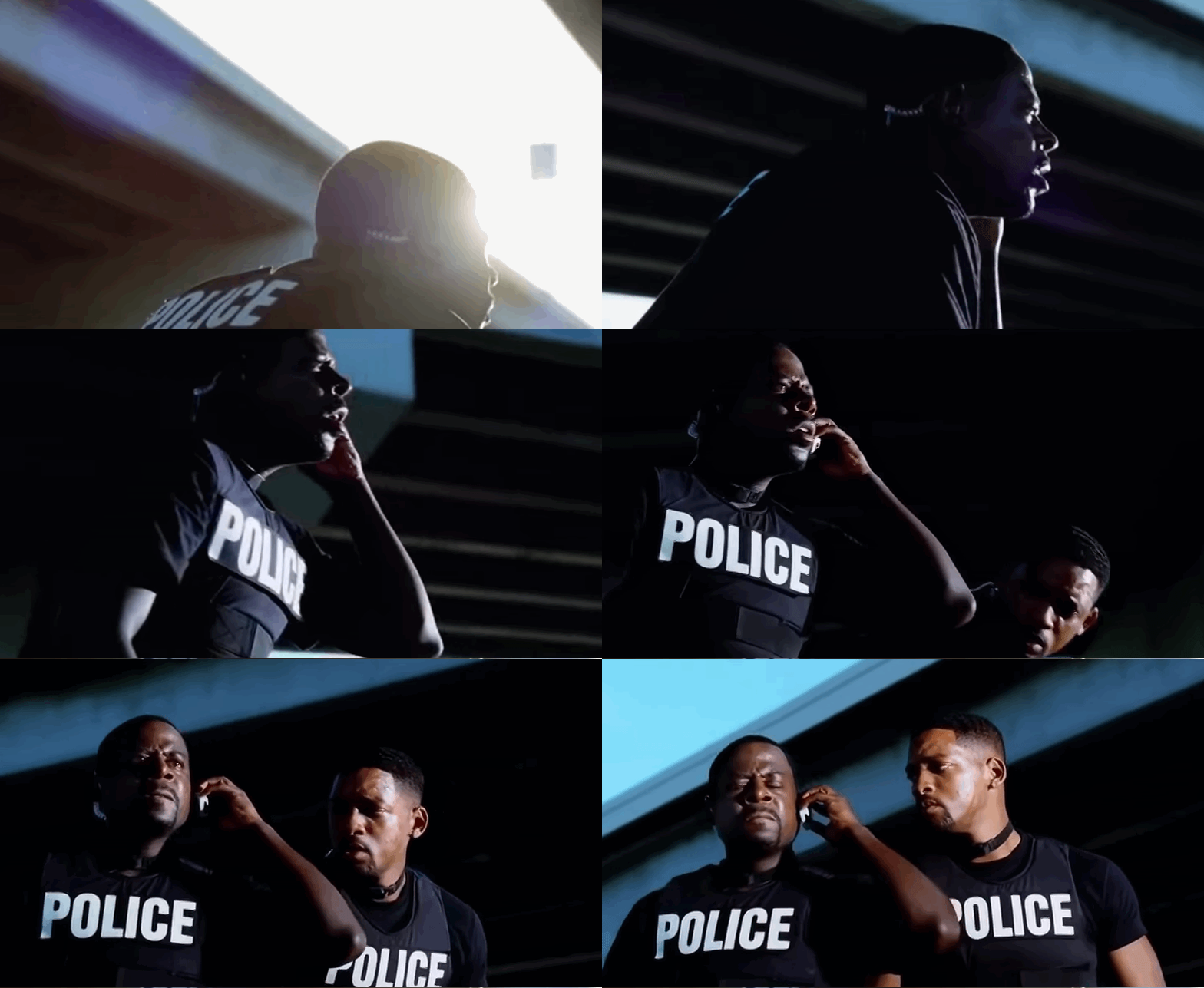
I could talk about what the distance from his work has done to change my preoccupation with him as a filmmaker, or even how I've only seen one his movies this year, Bad Boys II, which while just as much the riotous overstimulating nightmare that I wanted, I still only gave it five stars out of a sense of obligation. Instead I think what's far more interesting and insightful, than lazily talking about how I've grown away from a filmmaker who most people have never taken seriously to begin with, is to discuss how he came to be my favorite director in the first place.
This obviously demands that we talk about the much underseen Nineties throwback (in spirit), Ambulance.
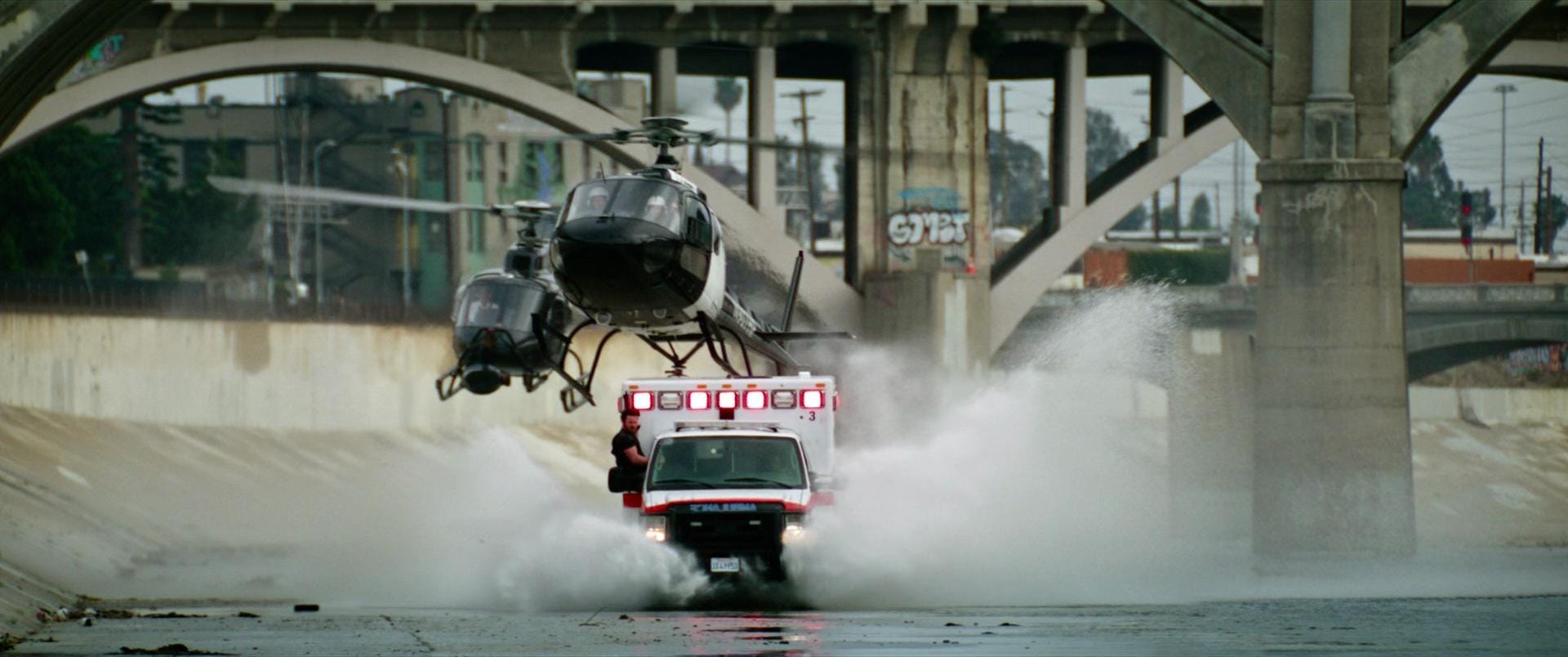
The sales pitch for Ambulance in my mind was a pretty easy slogan from day one: “Speed” meets “Heat”, or any other heist movie, take your pick. If you watched the trailer with just one eye cracked half open, you'd easily recognize it as the kind of thing that would be a staple of cable television re-runs in the early aughts (which is notably when I grew up watching movies). As a fan of hyper masculine genre films (Guy Ritchie's Wrath of Man is kind of single handedly responsible for me going full meathead movie mode) Ambulance was an easy shoe-in. A heist film with two terrific male leads in Jake Gyllenhaal (giving one of the most deranged, adrenaline fueled performances your likely to see this side of William Peterson in To Live and Die in LA) opposite Yahya Abdul-Mateen, who was quickly on the rise after Watchmen and the Candyman reboot. For the sake of covering all my bases, wouldn't say I was anticipating Eiza Gonzales role as much as her co-stars (as she's a female lead in a Michael Bay film, which is rough territory) but she more than matches both Gyllenhaal and Yahya Abdul-Mateen and to Bay's credit she's kind of the heart of the movie.
I couldn't for the live of me understood during Ambulance’s marketing campaign or eventually box office disaster, why people weren’t excited for a high intensity heist film, which looked a lot like a classic action movie from thirty years prior. It was my intentions to say “just thirty years prior” but as several other movies, both before and after Ambulance have proven, time and audience taste changes very, very quickly. As someone whose seen success and failure based on the changing tide of audiences desires, Michael Bay, is no stranger to Hollywood’s evolution. His first Transformers film was released in 2007 (co-produced by Spielberg) and by the time he’d completed his fifth and final film in the franchise in 2017, the box office curve on Bay had already more than peaked.
When Ambulance was released in 2022, while some of my snobbery toward certain kinds of genre films was behind me, I hadn’t much thought about Michael Bay as a filmmaker. The prospect of an exciting action flick amidst our dizzying wasteland of homogenous, boring superhero slop was something worth looking forward to. The idea that it was being directed by Michael Bay was neither a draw nor off-putting, a simple fact that hadn't bothered me much, one way or the other.
Up to this point my taste had shifted and expanded so much from what I initially found interesting that entertaining Michael Bay as a filmmaker wasn't really too far out. Seems like there should be an adage, if there isn't one already, about cinephilia and reclamation, and the inevitability of returning to the things you grew up with. Though my relationship with Bay's filmography was a very conscious and intentional act of interrogation (before turning into respect and appreciation), it was also very much akin to the act of reclaiming works that had defined my youth. While many people grew up with Star Wars, Lord of the Rings and various comic book films (many of which I also grew up watching) Bay was very much a filmmaker whose work loomed over a large part of my adolescence. As a self professed storyteller targeting the thirteen year old boy demographic, Bay was very much someone I watched in my youth.
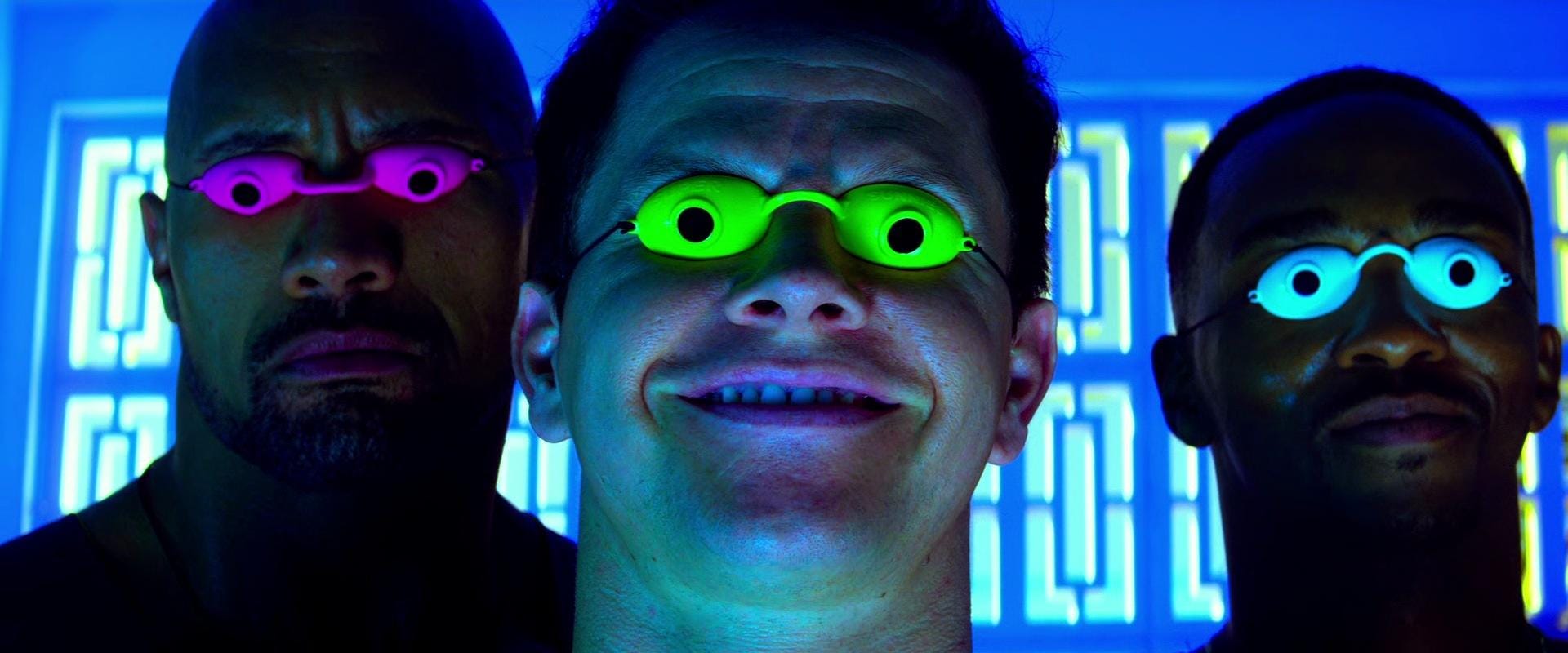
Beyond just Bay as a singular filmmaker, he was reflective of a different time and era, one I grew up just on the cusp of. While I remember watching the Bad Boys films and later on his Transformers movies (P.S. while I was in high school and Pain & Gain hit DVD shelves, watching that as like a family movie night was absolutely mind shattering stuff, movies like that are what directors work their entire careers to get carte-blanche for!) I also recall growing up with the movie's of Tony Scott like, Dejavu, The Taking of Pelham One Two Three, and Man on Fire. My nostalgia and interest in that era, returning to those things which I grew up with or recall my parents watching wasn't (or isn't) just for my younger self but for me as an adult. It, retroactively, is something I quite appreciate that blockbuster filmmakers like Bay and Tony Scott were behind movies that in my youth, were very much seen as black films.
Me “returning” to Bay's films coincided with an exploration of Tony Scott's work (the stuff I'd seen from his late career which I hold in the highest esteem) as well as his pre-2000s work which I had never watched. Cinephilia is this kaleidoscopic endeavor (like many things in life) one film, filmmaker, genre, etc. leads to another and so on. Bay inherently led me to his contemporaries, and his influences, it gave me the context for a different period of filmmaking. Not just Tony Scott, but also other great action filmmakers like John Woo. The more I watched Bay, the more I saw his significance across the history of the medium. He's not just the contemporary of other great filmmakers, but a singular and distinguished image maker whose work is in direct conversation with other greats. Sure it's incidental that my affinity for John Ford's body of work began right as I started to engage with Bay as a filmmaker. And also that I began to reappreciate Michael Mann's legacy and role in the tradition of great visual storytellers. And yet it's also quite sensible to draw these connections between these other artists even if they hover far above Bay, an artist work doesn't exist in vacuum but as a part of continuum. Bay is very much standing on the shoulders of greats, even if we choose not to recognize it, his work is clearly in conversation with the likes of Hitchcock, D.W. Griffith, John Ford, Orson Welles and more recent filmmakers like Steven Spielberg, David Fincher and Michael Mann.
The reasons I came to Bay may have been fueled by nostalgia for another era and a disdain for our modern factory style of filmmaking. But in it I found an artist of rare visual ingenuity, whose work (whose form) will certainly stand the test of time as the industry continues to erode simple artistic values in favor of an ever expanding bottom line.
As I say goodbye to Bay as my favorite director it's worth elaborating on one final idea. The act of choosing a favorite, of anything, artist included, it often tends to be a subconscious one. Many of my favorite filmmakers outside of Bay, like Terrence Malick and Barry Jenkins, weren't so much directors I chose, but ones whose work affected me so much so, that I could hardly think of a list of favorites without them. Bay one the other hand has shown me that the act can and should be a conscious act. Though there's not a single Bay movie I would say is as good as Malick or Jenkins work, I don't share the same level of enthusiasm for their films because they weren't the same conscious undertaking. It was more enjoyable to have a filmmaker whose body of work I had to interrogate and understand, it also didn't hurt that it was a very controversial pick that often asked that I immerse myself in truly vile and despicable depravity. On the subject of the depraved, I truly knew Bay was one of one for me when I watched, this Mark Kermode review of Pain & Gain which is just hilarious, and I couldn’t stop thinking about how committed Kermode was to stoking a moral panic over how repulsive he found the film, that’s a level of provocation that few filmmakers can inspire! Baytriot out 🫡
“What’s dead may never die”